
Introduction
As the global beauty market continues to grow, cosmetic brands are no longer limited to a single country for product development and manufacturing.
To stay competitive, brands must balance multiple factors including cost, quality, speed, and scalability. Relying on a single factory or one country is no longer enough.
This is where multi-country OEM manufacturing becomes a strategic advantage.
The Limitations of Single-Country Manufacturing
Many cosmetic brands begin by working with a single factory in one country. While this approach may seem simple, it creates several challenges as the brand grows.
Common limitations include:
-
Dependence on one production source
-
Limited flexibility when scaling
-
Higher risk of supply chain disruption
-
Difficulty optimizing cost across product lines
As market demand increases, these limitations can slow down growth and reduce competitiveness.
Different Countries, Different Strengths
In cosmetic manufacturing, each country offers unique advantages.
-
South Korea & Japan → advanced formulation, innovation, premium positioning
-
China → large-scale production, cost efficiency
-
Vietnam & Thailand → flexible production, competitive pricing
There is no single “best” country for all products. The key is selecting the right location for the right product.
What is Multi-Country OEM?
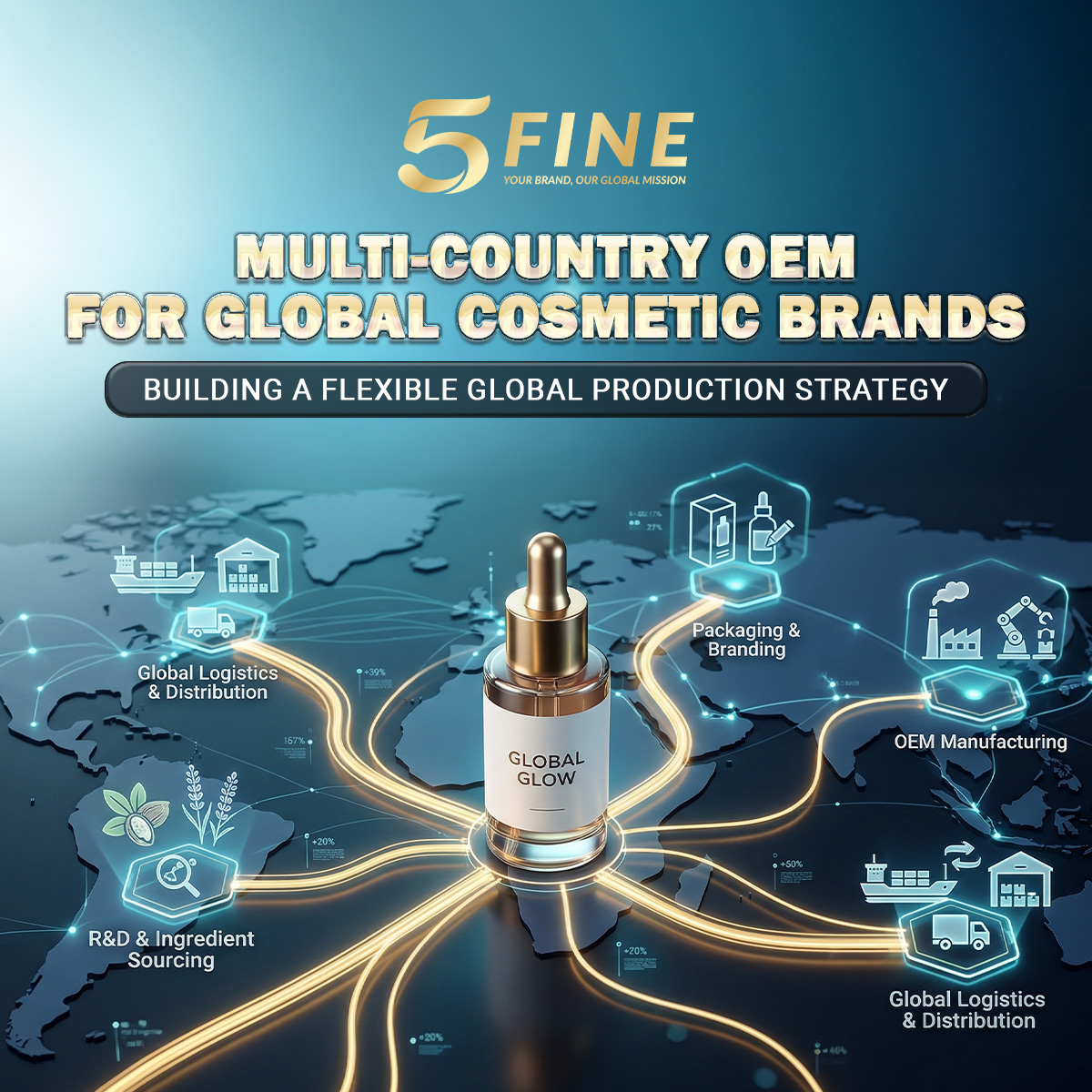
Multi-country OEM is a strategy where brands develop and manufacture products across multiple countries instead of relying on a single location.
This approach allows brands to:
-
Match product types with the most suitable manufacturing locations
-
Optimize cost without compromising quality
-
Diversify supply chain risks
-
Improve speed to market
It transforms manufacturing from a fixed process into a flexible system.
A More Strategic Way to Build Product Lines
With a multi-country approach, brands can structure their product portfolio more effectively.
For example:
-
Premium skincare developed in Korea
-
Cost-efficient products manufactured in China
-
Flexible product lines produced in Southeast Asia
This allows brands to align production with both market positioning and business strategy.
From Manufacturing to Global System
Multi-country OEM is not just about producing in different locations.
It is about building a connected system where:
-
formulation
-
packaging
-
production
-
logistics
are aligned across multiple regions.
This creates a more resilient and scalable production model.
The Role of 5FINE in Multi-Country OEM
At 5FINE, we act as a bridge between brands and a network of manufacturing partners across multiple countries.
Our role is to help brands:
-
Identify suitable manufacturing locations
-
Coordinate production across regions
-
Align product development with global supply chain strategies
-
Optimize cost, quality, and efficiency
By connecting multiple production resources into one system, we help brands operate more flexibly and scale globally.
Why This Strategy Matters for Global Brands
Brands that adopt a multi-country OEM strategy can:
-
Reduce dependency risks
-
Improve cost efficiency
-
Increase speed and flexibility
-
Expand into global markets more effectively
In a competitive beauty industry, this flexibility becomes a key advantage.
Conclusion
The future of cosmetic manufacturing is no longer about choosing a single factory.
It is about building a flexible, multi-country system that adapts to different product needs and market demands.
Brands that embrace this strategy will be better positioned to grow, scale, and compete globally.
