Packaging That Sells: Structure, Finish & Unboxing Guide
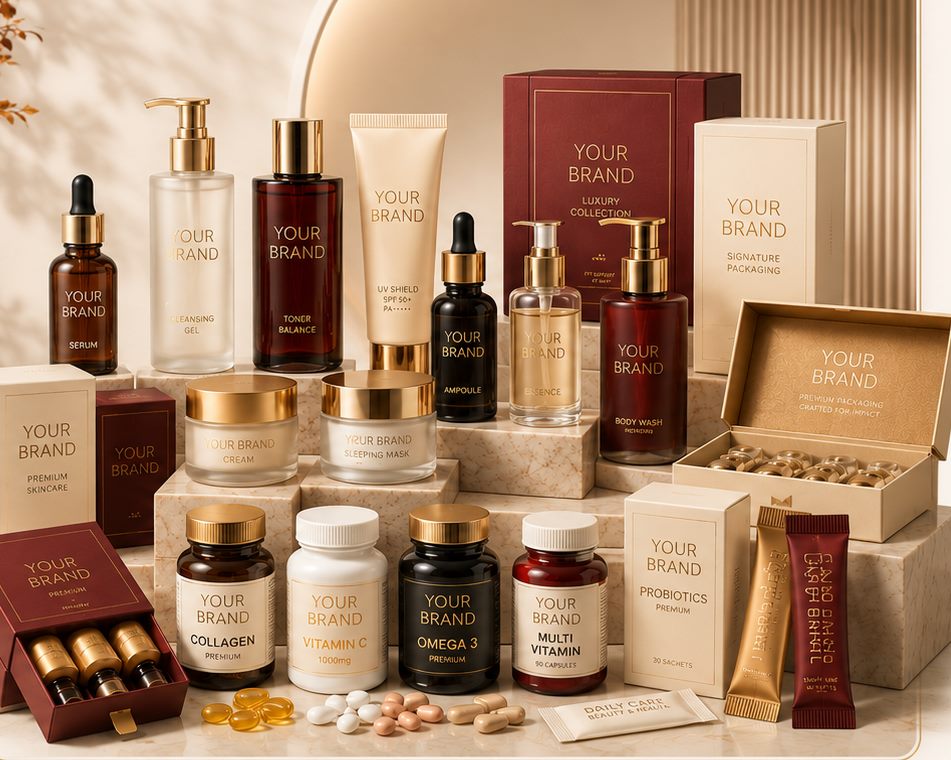
Customers judge a beauty product in seconds, often from a phone-sized thumbnail or a crowded shelf. Packaging is the part of your brand they touch first, and the part that is hardest to change once a production run is printed. This guide explains how to choose structure, finishes and unboxing details that support your positioning, protect the formula and keep your costs under control.
Start with where you will sell
The right packaging depends on the channel more than on taste. Before you look at bottles, write down where most of your sales will happen:
- Marketplaces and social commerce: the product is seen first as a small image or in a live stream. Strong silhouette, bold colour blocking and a clearly readable product name matter more than fine detail.
- Retail shelves and pharmacies: the pack needs to stand upright, read well from a distance and carry the required label text in the local language.
- Clinics, spas and salons: professional, clean designs and practical dispensers (pumps, larger sizes) fit the setting.
- Gifting and seasonal sets: secondary packaging, inserts and the opening moment carry most of the value.
Structure communicates positioning
Form tells the customer what kind of product they are holding before they read a word. Heavy glass and architectural caps suggest premium; airless pumps and soft tubes suggest modern, clinical and hygienic; simple PET bottles suggest everyday value. Each choice also affects cost, minimums and how the product travels.
| Option | What it affects | Cost impact |
|---|---|---|
| Stock PET or PP bottle | Fast sourcing, lighter shipping, value positioning | Lower |
| Laminated or PE tube | Squeeze dosing, good for cleansers and creams | Lower to medium |
| Airless pump | Protects sensitive actives, clinical look | Medium |
| Glass bottle or jar | Premium feel, weight, breakage risk in shipping | Medium to higher |
| Custom mould | Unique shape, one-time tooling, higher minimums | Higher |
For a first launch, many brands get a distinctive look by combining a stock structure with a custom colour, cap or decoration. You can browse common formats on our cosmetic packaging page.
Finishes: one considered detail beats three loud ones
Decoration is where perceived value is created. Common options include soft-touch coating, hot-foil stamping, embossing or debossing, spot UV, metallised caps, frosted glass and silk-screen printing directly on the container. Each adds a process step, and some add a separate minimum or extra lead time, so pick one hero detail that expresses your brand and keep the rest clean. A matte bottle with a single foil logo often looks more expensive than a pack carrying every finish at once.
Ask for a physical sample of the decoration on the real component. Colours shift between screen, paper proof and plastic, and foil or soft-touch can behave differently on curved surfaces.
Design the unboxing for online buyers
For e-commerce and gift sets, the moment of opening is part of the product. A fitted insert, a printed inner flap, a short thank-you card or a QR code leading to usage tips can turn a delivery into something customers want to film and share. Keep it functional: the insert must stop the product moving in transit, and the outer mailer must survive courier handling. A beautiful box that arrives crushed works against you.
Function, compatibility and compliance
Packaging that sells also has to work. Before approving, check:
- Formula compatibility: oils, essential oils, alcohol and some actives can react with certain plastics. Your manufacturer should run compatibility and stability checks with the real pack.
- Dispensing: pump output, viscosity and nozzle type must match the texture, or customers will struggle to get product out.
- Leakage and transport: caps, seals and inner plugs matter for shipping, especially by air.
- Label space: ingredient lists, warnings, batch codes and multi-language text need room. Small formats fill up quickly.
Sustainability without greenwashing
Retailers and buyers increasingly ask about recyclability, PCR (post-consumer recycled) content and refills. Mono-material packs, refill pouches and lighter components can support your story, but only make claims you can document. "Recyclable" depends on local collection systems, and PCR resin can vary slightly in colour. Our guide to refillable and PCR cosmetic packaging covers the trade-offs in detail.
Common packaging mistakes to avoid
- Choosing the bottle before the formula is final, then discovering the texture does not dispense well.
- Ordering custom moulds for a first launch, before you know which products repeat.
- Designing artwork without checking the regulatory text each market requires.
- Approving colours from a screen instead of a physical sample.
- Forgetting secondary packaging and shipping protection in the budget.
- Making sustainability claims that the materials cannot support.
5FINE helps brands choose structure, finishes and materials that fit their positioning and budget, with packaging sourced alongside the formula through our certified partner factories. Our packaging design service can also prepare artwork and dielines. When you are ready, start your brand brief and we will suggest options for your product.
FAQ
Should my first launch use stock or custom packaging?
Most new brands start with stock structures and customise them with colour, decoration and labels. Custom moulds add a one-time tooling cost and higher minimums, so they usually make more sense once a product has proven demand.
How does packaging affect my minimum order?
Each component (bottle, cap, pump, carton) can have its own minimum, and printed or decorated items often have higher minimums than plain stock. Packaging is frequently what sets the overall MOQ, which is confirmed in your quotation.
Why does the manufacturer need to test my packaging with the formula?
Some ingredients can soften, stain or permeate certain plastics, and pumps may not suit every texture. Compatibility and stability checks help catch these problems before production.
Do I need an outer box for every product?
Not necessarily. Many brands skip cartons for value products and use direct printing or labels. Boxes add protection, label space and premium feel, so decide based on channel and positioning.
This article provides general industry information for planning purposes only. It is not a quotation, offer, guarantee or legal/regulatory advice from 5FINE. Actual MOQs, pricing, timelines and regulatory requirements depend on the product and market, and are confirmed only in a formal quotation.