How Much Does It Cost to Start a Skincare Brand in Thailand?
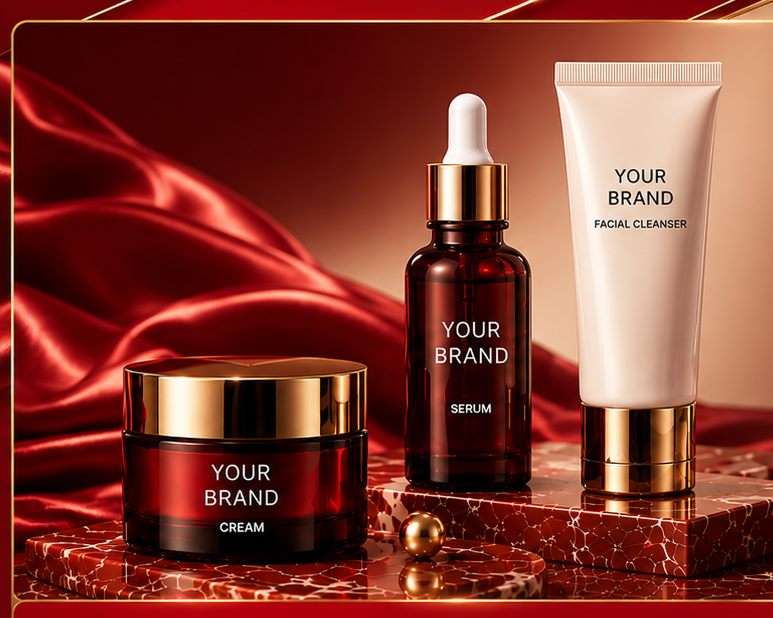
Founders usually ask the same first question: how much do I need to launch a skincare line manufactured in Thailand? The honest answer is that the budget depends on a handful of decisions — formula route, packaging, testing, design and launch marketing — and each of them can be set lean or premium. This guide walks through the cost buckets we review with every 5FINE client, so you can plan before you request a quotation.
Why Thailand is a practical place to start
Thailand offers GMP- and ISO-certified cosmetic factories, a mature supply chain for actives and packaging, an established cosmetic notification system, and export routes already running to the Middle East, ASEAN, Europe and beyond. For mainstream categories — serums, creams, cleansers, sunscreen, masks — it is often a cost-competitive option, while other manufacturing countries have their own specialities. That is why many Gulf, Southeast Asian and European founders consider it for a first line; see our guide on why brands choose cosmetics manufacturing in Thailand.
The five cost buckets
Every skincare launch, whatever the brand, pays into the same five buckets. Fixed numbers only mean something once your formula, packaging and quantities are defined, so here is what moves each bucket up or down.
| Cost bucket | What it covers | What drives it | Cost impact |
|---|---|---|---|
| 1. Formula & filling | Bulk formula, filling, in-process QC | Actives (peptides, ceramides, vitamin C), texture complexity, proven vs custom base | Usually the largest per-unit line |
| 2. Packaging | Bottle, pump, cap, label, carton | Glass and airless cost more than stock PET; custom moulds and printed tubes add tooling | Lower (stock) to higher (custom) |
| 3. Compliance & testing | Stability, challenge test, safety assessment, notification | Number of SKUs and markets; SPF claims need laboratory testing | One-time per product |
| 4. Brand & design | Logo, label artwork, carton dieline | Lean designer kit vs full agency identity | Lower to higher |
| 5. Launch & marketing | Photos, online store, first content and ads | Channels and how fast you want to scale | Plan it from day one |
Formula and filling — usually your biggest line. A proven base (hydrating gel-cream, niacinamide serum, gentle foaming cleanser) is the most budget-friendly way to start because the formula is already stable and tested. Adjusting scent, colour, texture or active level — what we call semi-custom — adds a little per unit but gives you a product that is recognisably yours. Fully custom development from a blank brief adds a development fee and extra time for stability work; most first-time brands do not need it.
Packaging — where budgets quietly break. Packaging is the most under-estimated line in most founders' spreadsheets. A stock PET bottle with a printed label sits at the low end; a frosted glass dropper with a hot-stamped carton sits well above it. Each component (bottle, pump, cap, carton, label) carries its own minimum, so custom moulds or printed tubes push both quantity and cash up quickly. A good rule for a first run: stock packaging, great label design. You can browse real examples in our product and packaging gallery.
Compliance and testing. For Thailand-made cosmetics you will typically budget for stability testing, a preservative challenge test, a product information file or safety assessment for markets that require one (such as the EU), and Thai FDA notification. If you plan to sell in the UAE or Saudi Arabia, Halal certification is worth considering at this stage. Sunscreen is the exception: an SPF number requires laboratory testing, which adds both time and a separate line item — read our sunscreen manufacturing guide before you brief an SPF product.
Brand and design. You need a logo, a label system and a carton layout. A focused designer can deliver a clean, shelf-ready kit for a fraction of what a full agency identity costs. Start lean — the formula and the photography sell more than a thick brand book.
Launch and marketing. Founders who run out of money usually spent it all on stock. Reserve a meaningful share of your total budget for photography, a simple storefront and your first content or ad tests. Beautiful units in a warehouse with no marketing budget is one of the most common ways a new skincare brand stalls.
Three budget profiles
Rather than quote amounts that would not match your project, it helps to think in profiles. Your quotation then puts real figures against the profile you choose.
| Profile | Typical scope | Relative budget | Best for |
|---|---|---|---|
| Lean test launch | 1 hero SKU, proven formula, stock packaging, printed label, essential testing | Lowest | Validating a market |
| Starter range | 3 SKUs (cleanser, serum, moisturiser), semi-custom formulas, stock bottles with branded cartons, full testing, proper photography | Medium | Brands with an audience ready to buy |
| Premium line | 3–5 SKUs, custom actives, glass or airless packaging, Halal and multi-market dossiers | Highest | Funded brands entering GCC or EU retail |
How timing affects your budget
Time is a cost too: the longer a project runs, the longer your cash is committed before the first sale. Proven formulas with stock packaging are the fastest route; custom formulas, SPF testing and custom packaging moulds each add development and testing stages. Timelines depend on the product, packaging and registration, and your schedule is confirmed in the quotation. Plan your launch date backwards from that confirmed schedule rather than from a campaign date.
Five ways to launch for less
- Start with one or two hero SKUs, not a ten-product range.
- Choose a proven or semi-custom base over full custom development.
- Use stock packaging and put the money into label design instead.
- Order what you can realistically sell before your next reorder — our MOQ guide explains how this protects your cash flow.
- Work with a one-stop development partner so compliance, packaging and export documents are coordinated instead of paid to five separate vendors.
Get a real number for your brand
Cost drivers are useful; a quotation is better. Tell us what you want to launch — category, target market, rough quantity — and our team can prepare a line-by-line estimate covering formula, packaging, testing, minimums and schedule, under NDA. Start your brand or contact our team.
FAQ
What is the minimum budget to start a skincare brand in Thailand?
It depends on the number of SKUs, the formula route and the packaging. The leanest route is a single hero product on a proven formula with stock packaging and essential testing. Skipping testing or design to save money usually costs more later.
What MOQ should I expect from a Thai OEM partner?
Minimums start low for proven formulas and stock packaging. MOQ depends on the product and packaging and is confirmed in your quotation; packaging components, not the formula, are usually what push minimums higher.
Is it cheaper to manufacture skincare in Thailand than in Korea?
Thailand is often cost-competitive for mainstream categories, while Korea is well known for specialised textures and actives. 5FINE works with certified partner factories in Thailand, Korea, Japan and Dubai, so each product can be made where it fits best.
Do I own the formula?
With 5FINE, the client owns the brand, the artwork and any custom formula developed for them, and projects run under NDA. Whoever you work with, make sure ownership is written into the agreement.
This article provides general industry information for planning purposes only. It is not a quotation, offer, guarantee or legal/regulatory advice from 5FINE. Actual MOQs, pricing, timelines and regulatory requirements depend on the product and market, and are confirmed only in a formal quotation.