Understanding MOQ: How Much Stock Do You Need to Start?
"What's your MOQ?" is one of the first questions every founder asks a manufacturer, and one of the most misunderstood. Minimum order quantity is not a single number that applies to everything; it is the result of several components, each with its own minimum. This guide explains how MOQ works, what pushes it up or down, and how to plan a first order that protects your cash flow.
What MOQ actually is
MOQ is the smallest quantity a manufacturer can produce in one run while keeping the job practical. It exists because every run has fixed setup work: weighing and mixing a batch, cleaning and setting up the filling line, preparing printing plates or screens, and running quality checks. Below a certain volume, that setup is spread over too few units to make sense for the factory, or the per-unit price becomes unattractive for you.
Why MOQ varies so much between products
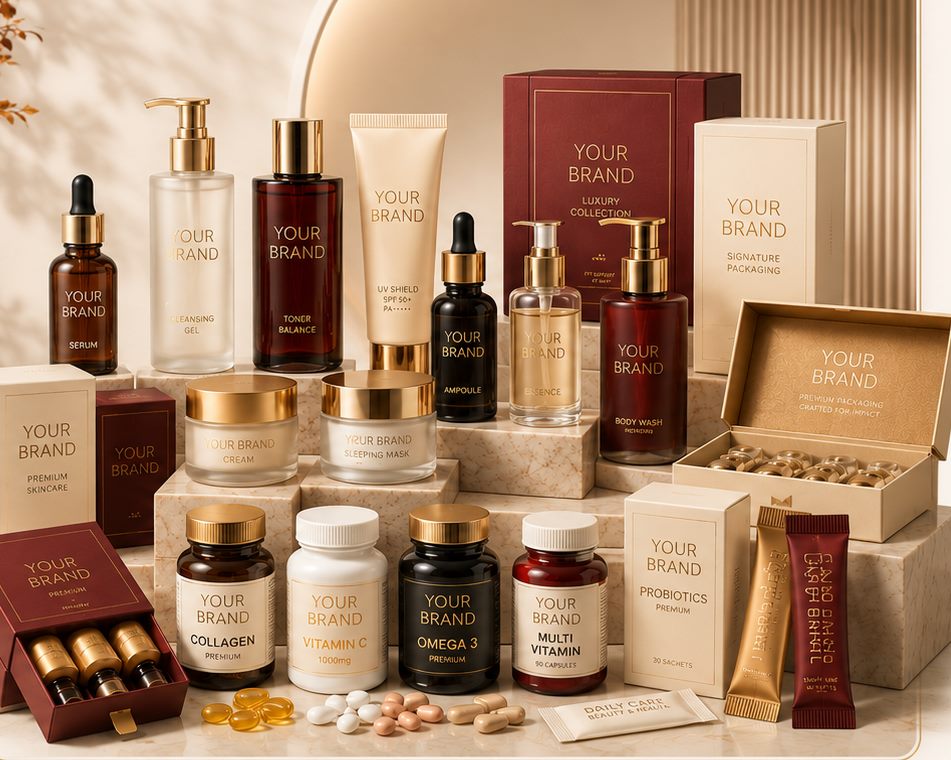
MOQ depends on the product and the packaging. A simple balm in a stock tin may start low, while a custom serum in a decorated airless pump with a printed carton sits higher, because the pump, the decoration and the carton each have their own minimum from their suppliers. In many projects, packaging, not the formula, is what sets the overall MOQ.
| Factor | What it affects | Impact on minimum |
|---|---|---|
| Proven formula vs custom formula | Batch size and development work | Lower for proven, higher for custom |
| Stock packaging vs custom mould | Component minimums and tooling | Lower for stock, higher for custom |
| Labels vs direct printing on containers | Decoration setup per design | Labels lower, printing medium to higher |
| Printed carton vs no carton | Paper and printing minimums | Medium when added |
| Number of shades, scents or variants | Separate batches or decorations per variant | Higher as variants multiply |
| Special finishes (foil, soft-touch, custom colour) | Extra process steps | Medium to higher |
For a fuller look at how MOQ, timeline and cost connect, see our guide to OEM cosmetics manufacturing in Thailand.
How to start with a lean first order
- Use stock packaging for your first run and customise it with colour, labels or a single decoration. You can browse formats on our packaging page.
- Launch one or two hero SKUs instead of a full range. Fewer SKUs means fewer separate minimums.
- Start from a proven or semi-custom formula to avoid development batch minimums.
- Limit variants: two shades or scents instead of six keeps each run viable.
- Use labels or stickers on plain components rather than fully printed containers for a first test.
Planning which products form your core range helps here; see how to structure a hero product and supporting SKUs.
Plan for cash flow and sell-through, not only unit price
A lower per-unit price at a much larger quantity is no bargain if it ties up your cash in unsold stock. To estimate a realistic first order, work through:
- Channels: how many places will sell the product at launch (your website, marketplaces, distributors, clinics)?
- Expected sales pace: a conservative estimate per channel, based on your audience, pre-orders or distributor commitments.
- Reorder time: how long a repeat order takes to arrive, so you reorder before running out.
- Shelf life: cosmetics and supplements have expiry dates; buyers and retailers often expect a good share of shelf life remaining on delivery.
- Samples and marketing stock: units for influencers, testers and gifting come out of the same order.
Order what you can realistically sell in your first few months, then reorder once you have real data. A second order based on actual sales is usually a better investment than a large first order based on hope, and it gives you the chance to adjust scent, packaging or claims after hearing from real customers.
Supplements follow the same logic, with one difference: capsule, gummy and sachet lines often have batch minimums set by the encapsulation or packing machine, so ask which format gives you the most flexible starting point.
Questions to ask your manufacturer about MOQ
- Is the MOQ per SKU, per variant or per order?
- Which component is setting the minimum: formula, container, cap, label or carton?
- Can several scents or shades share one base batch?
- How does the unit price change at different quantities?
- How are small overages or shortfalls in a production run handled?
- Is the reorder minimum the same as the first order?
Common MOQ mistakes
- Comparing quotes only by unit price without comparing the quantity behind it.
- Ordering custom packaging for a product that has not been tested in the market.
- Launching many variants, each forced up to its own minimum.
- Forgetting that leftover printed packaging becomes waste if the label or regulation changes.
There is no single MOQ that fits every brand. With 5FINE, minimums start low for proven formulas and stock packaging, and the exact figure for each SKU is confirmed in your quotation. Send us your product idea and we will suggest the leanest way to start.
FAQ
Is there a standard MOQ for cosmetics?
No. MOQ depends on the product, the formula route and especially the packaging. It is confirmed per SKU in your quotation.
Why is the packaging minimum often higher than the formula minimum?
Containers, caps, pumps and cartons come from separate suppliers, each with its own production minimum. Custom colours and printing add further setup, which raises the quantity needed.
Does a smaller order cost more per unit?
Generally yes, because setup work is spread over fewer units. A slightly higher unit price on a smaller first order can still be the smarter choice for cash flow.
Can I split one MOQ across several scents or shades?
Sometimes. If variants share the same base and packaging, a manufacturer may be able to split a run. Ask early, because it depends on the product and the components.
This article provides general industry information for planning purposes only. It is not a quotation, offer, guarantee or legal/regulatory advice from 5FINE. Actual MOQs, pricing, timelines and regulatory requirements depend on the product and market, and are confirmed only in a formal quotation.